
Own Priority Topics
Develop connected coverage around the services, products and expertise the brand genuinely wants to be known for.
Turn search demand into a connected content system that strengthens commercial pages, demonstrates genuine expertise and helps your brand become a trusted source across Google Search and AI-assisted discovery.
Topical authority does not come from publishing dozens of disconnected articles. It comes from covering the right subject in meaningful depth, organising that knowledge clearly and connecting it to the pages that drive business.
Develop connected coverage around the services, products and expertise the brand genuinely wants to be known for.
Support customers from early education through comparison, evaluation and the final commercial decision.
Use contextual internal links and supporting evidence to reinforce the relevance of priority service, category and product pages.
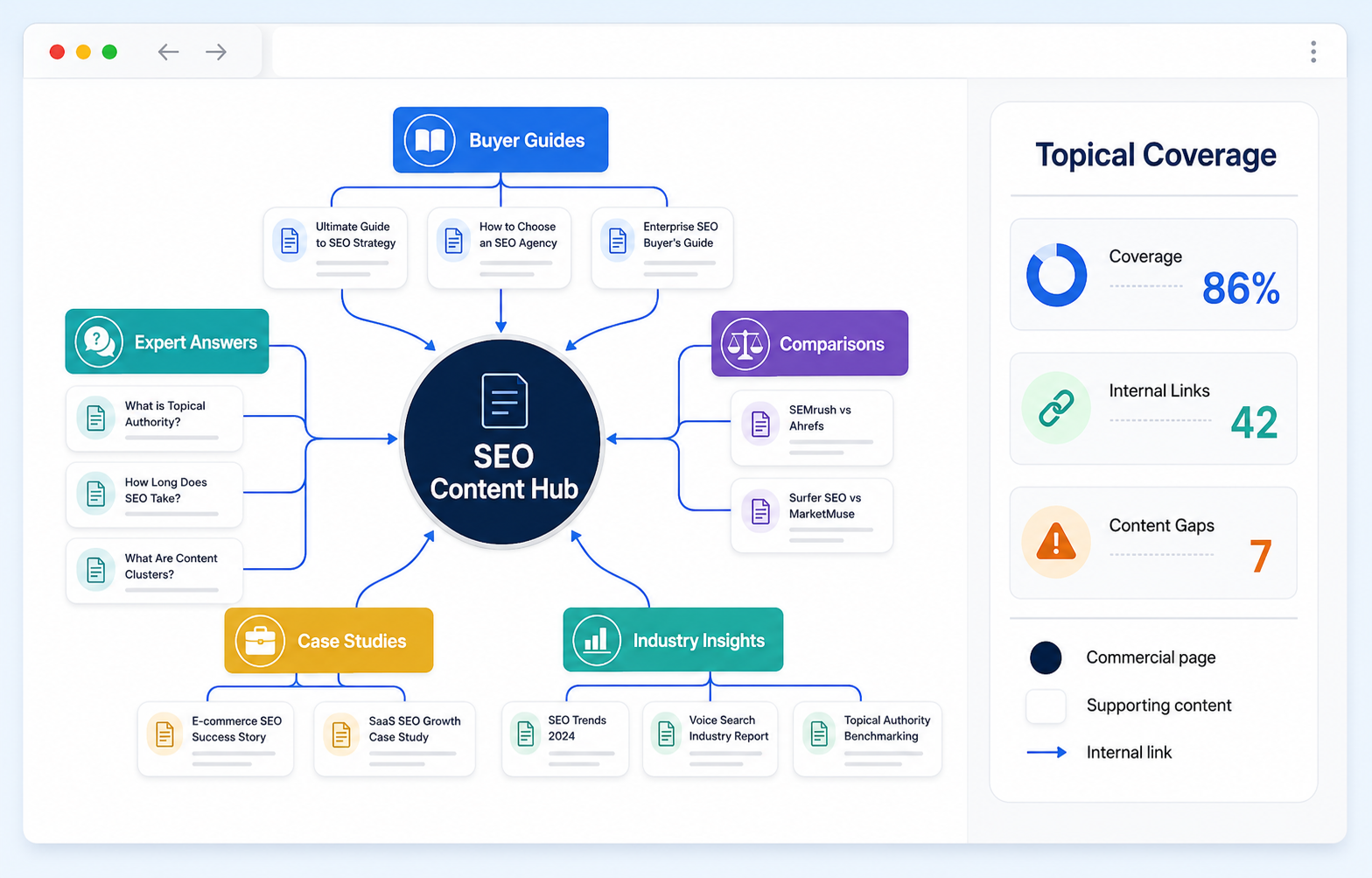
A topic cluster connects a central commercial or definitive page with supporting guides, answers, comparisons, case studies and original insights. Each page has a distinct purpose and contributes context to the wider subject.
The service can cover strategy, briefs, creation, optimisation and ongoing improvement—or provide the research and editorial framework for your internal writers.
Review existing coverage, performance, duplication, cannibalisation, weak pages, internal links, competitors and priority gaps.
Explore content auditsMap search demand, entities, questions, modifiers, intent and content relationships beyond a flat spreadsheet of keywords.
Explore topic researchDecide which subjects belong on commercial pages, supporting resources, hubs, comparisons, FAQs or consolidated guides.
Explore content architectureProvide writers with intent, audience, structure, entities, evidence requirements, internal links and a clear purpose for the page.
Explore content briefsCreate commercially focused pages that explain value clearly, answer decision-stage questions and support qualified enquiries.
Explore landing-page copyDevelop collection, category, buying-guide and product-support content aligned with how customers filter, compare and purchase.
Explore ecommerce contentProduce useful long-form resources and focused answers that satisfy real questions while supporting wider topical coverage.
Explore expert contentHelp customers evaluate options honestly through use-case comparisons, alternatives, advantages and decision criteria.
Explore comparison contentTurn internal expertise, data, experience and opinions into distinctive assets worth referencing and remembering.
Explore thought leadershipUpdate decaying pages, merge overlapping articles, resolve cannibalisation and redirect content that no longer deserves a standalone URL.
Explore content refreshingConnect supporting content with hubs and commercial pages using useful anchors and genuine contextual relationships.
Explore internal linkingReview factual accuracy, clarity, intent, structure, duplication, metadata, accessibility, links and conversion journeys before publication.
Explore editorial SEOUseful content must do more than include keywords. It should satisfy the reader, demonstrate real knowledge, connect logically with the site and earn enough trust to compete.
Match the format, depth and purpose to what the customer is actually trying to accomplish.
Add expert input, examples, original observations and reliable supporting information.
Organise pages and internal links so the wider subject is coherent rather than fragmented.
Support the content system with relevant external validation and genuine brand prominence.
Different questions require different formats. The strategy chooses a page type based on intent and business value—not because the editorial calendar needs another blog post.
Strong topical coverage can support traditional rankings while also giving AI-assisted systems clearer source material, entities, evidence and relationships to retrieve.
Identify customer journeys, subtopics, entities, questions and evidence gaps.
Produce clear, distinctive content with expertise and appropriate supporting evidence.
Use hubs, navigation and internal links to establish relationships across the topic.
Develop external mentions and links that validate the brand’s subject expertise.
AI tools can assist research, organisation and editing, but they do not replace subject expertise, fact checking, original experience or editorial accountability.
Understand the customer, intent, existing results, internal knowledge and evidence requirements before deciding what the page should say.
Capture the practical details, opinions, examples and experience that generic summaries cannot reproduce.
Check accuracy, originality, clarity, usefulness, internal consistency and brand voice before any content is published.
The programme prioritises the content that can unlock the strongest commercial and topical gains, then improves the system using actual performance.
Assess existing pages, competitors, demand, customer journeys and authority gaps.
Assign topics and intent to commercial hubs, supporting content and internal links.
Brief, write, review, publish and connect genuinely useful pages.
Track visibility, engagement, conversions and coverage while updating what declines.
Topical authority describes the depth, quality and coherence of a website’s coverage around a particular subject. It is strengthened by useful content, logical architecture, contextual internal links, demonstrated expertise and credible external validation.
Google does not publish a single “topical authority score”. The term describes a strategy built from signals search engines do use, such as relevance, content quality, internal relationships, expertise, links and broader site reputation.
SEO content creation describes the production component, while content marketing can also include distribution through social, email and paid channels. “SEO Content & Topical Authority Services” better represents the complete research, architecture, creation, optimisation and internal-linking strategy offered here.
There is no fixed number. A narrow subject may need a small set of definitive pages, while a complex market may require extensive coverage. Quality, intent coverage, organisation and authority matter more than hitting an arbitrary publication count.
Yes. The service can provide topic strategy, briefs, templates, internal-link plans and editorial QA for an internal team, or manage the complete content creation process.
AI can assist with research organisation, ideation and editing, but final content should be shaped by real expertise, fact checking, original input and human editorial review. The goal is useful source material, not high-volume generic copy.
Share your website, priority services or products and the subjects you want the brand to own. I’ll take an initial look at the existing coverage and strongest opportunities.
No content-for-content’s-sake—every recommended page should have a clear audience, search purpose and strategic role.
Include your website and the products, services or topics you want to strengthen.